
An Evolution in SaaS: The Median Company has a Positive Operating Margin

Quite a lot has happened in the land of software as a service (SaaS) in the past several months. Concern over AI and its impact on SaaS companies accelerated, reaching near full-throated panic in the wake of Anthropic’s releasing multiple open-source plug-ins for Claude Cowork in late January. The SaaS Capital IndexTM (SCI) of publicly traded SaaS companies, already showing weakness in 2025, tumbled nearly 26% in the first two months of 2026 while dire portmanteaus proliferated: SaaSpocalypse, SaaSmageddon, SaaSacre.
In the short term, the market is a voting machine. At the start of the year the market was clearly voting for AI to be an extinction-level risk to the SaaS industry. At SaaS Capital we take another view, believing AI to be an evolutionary force in SaaS. Its adoption will drive margin compression or obsolescence in vulnerable businesses while enhancing pricing power and growth in companies best positioned to take advantage of it (see AI risk to SaaS). We also recognize the difference between a good stock and a good company, and as lenders, we place greater emphasis on the latter.
To this end, we want to call attention to a recent development in the SCI that may otherwise go unnoticed among the deluge of AI-related headlines. For the first time in more than a decade, the median company in the SCI is generating an operating profit. From a nadir of -21% in mid-2022, the median operating margin increased to +3% as of February 2026. World-beating this is not. But it does represent a noteworthy and sustained trend.
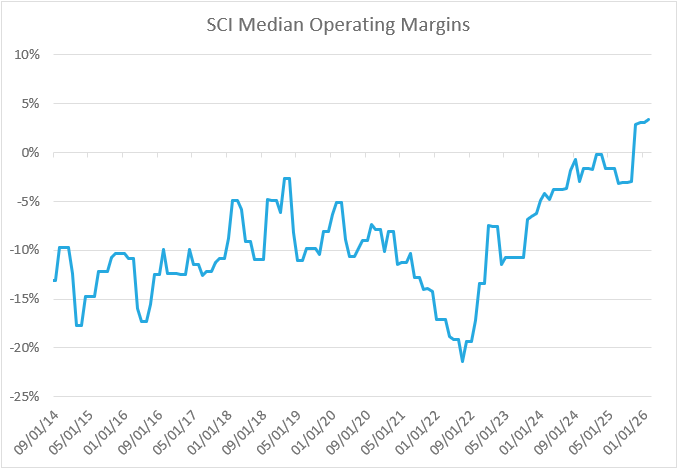
We recommend readers watch this metric going forward to help evaluate how the SaaS industry is faring. At the individual company level, operating margins can help identify which companies are best positioned to manage an uncertain future. Profitability reduces vulnerability to external financial conditions and increases operational flexibility. As we say to the private SaaS companies to which we speak, getting to profitability is the best way to control your destiny in this environment. It is no different for public companies.
Interest rates and profitability
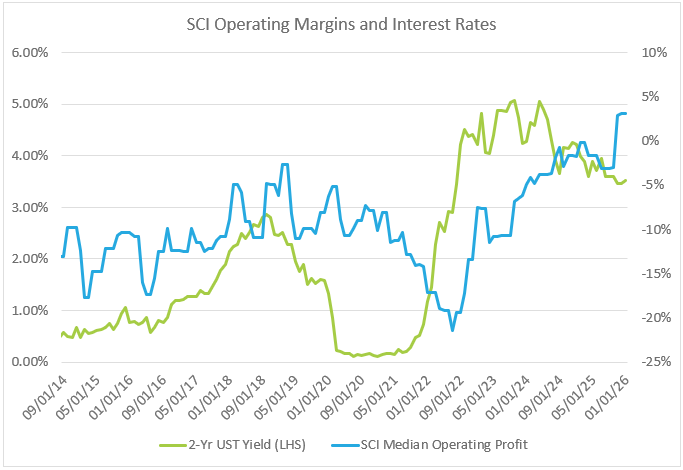
Digging into the drivers behind the turnaround in operating margin, we present the following chart of the SCI median operating margin overlaid with the US 2-year treasury note yield. The two variables have moved in broad concert over the past decade plus, with operating margin lagging trend changes in interest rates (changes in corporate strategy take longer to manifest in operating results).
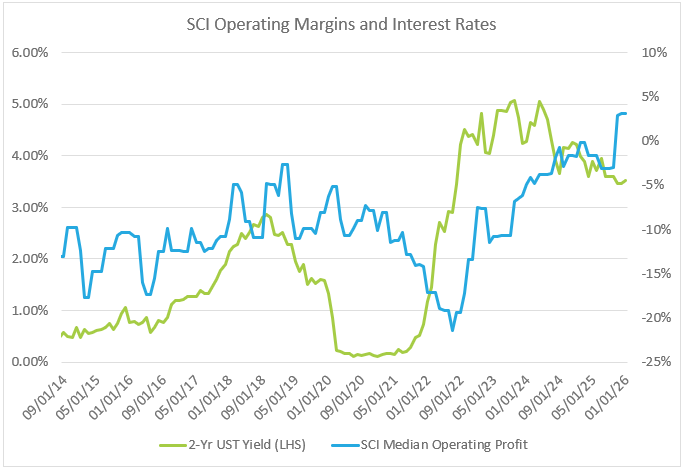
This relationship makes intuitive and economic sense. As the cost of capital, proxied here by yields on the 2-year note, rose from 2014 through 2019, SaaS companies reduced their operating losses as financing these losses became more costly. When rates started to decline prior to (and then tumbled at the onset of) Covid, companies increased their spend and prioritized growth over profitability. (Note the impact of this on operating margins was exacerbated at the index level by the rash of unprofitable SaaS company IPOs in 2021 and early 2022 that were added to the SCI).
As interest rates rose sharply through 2022 and 2023, the median company responded by once again reining in spending. This trend continued as interest rates remained stubbornly high (or at historically normal levels for those willing to consider pre-GFC financial history) throughout 2024 and 2025.
Of course, other factors impact operating margin besides trend changes in interest rates. The point is not to advocate for a monocausal explanation. But at a time when AI has become a dominating explanatory lens, we want to call attention to another factor driving the evolution of the SaaS industry in recent years. Importantly, the industry’s shift to profitability in the wake of higher rates leaves it in a stronger position to respond to the other forces shaping it, not least of which is AI.