
.org vs .com: Which Should You Choose?


You’re at a party and someone introduces themselves like this:
“Hi, I’m Steve Dot Com.”
Another person chimes in, “Nice to meet you. I’m Karen Dot Org.”
Who do you trust more? Are you wondering if Steve might try to sell you something? Thinking that Karen might organize fundraisers for baby sea turtles in her spare time?
That’s the problem with domain extensions: they come with baggage. The internet has now been around long enough that “.com” kind of feels like the default, while “.org” automatically makes our brains go “nonprofit!” But are those assumptions actually true?
The short answer: kind of. The shorthand is old — .com for commercial, .org for organizations — but neither extension is restricted today. Anyone can register either one, and Public Interest Registry calls .org “open and unrestricted.” So the real difference is branding, audience expectation, and availability: businesses take the .com, mission-driven groups take the .org.
So, should you get a .com or a .org?
What really matters, and what doesn’t?
And how do you pick a domain extension that won’t come back to bite you later?
Let’s dig in.
Pick .com if you sell anything or want the broadest, safest read from strangers. Pick .org if your work is mission-driven and you want people to see that at a glance. Neither one is restricted, and neither one ranks better in Google. Here’s the side-by-side:
If you’ve ever Googled “best domain extension,” you’ve probably stumbled into an avalanche of half-baked advice:
“.com is the only way to rank in Google!”
“.org instantly makes you look more trustworthy!”
“Your startup isn’t legit unless you launch with .ai!”
.com is by far the most-registered extension, and .org is one of the best known, but you can actually use just about any extension you want.
Actually, it’s subject to just a few rules. For example, you can’t use spaces or non-printable characters, and a few extensions really are restricted: get.gov states that only verified U.S. government organizations can register and operate a .gov domain, while “anyone can register a .com, .org, or .us domain for a fee.”
Beyond that, though, TLD fads have come and gone during the lifespan of the internet, so what really matters is choosing a domain that fits your brand, makes sense to your audience, and sets you up for success.
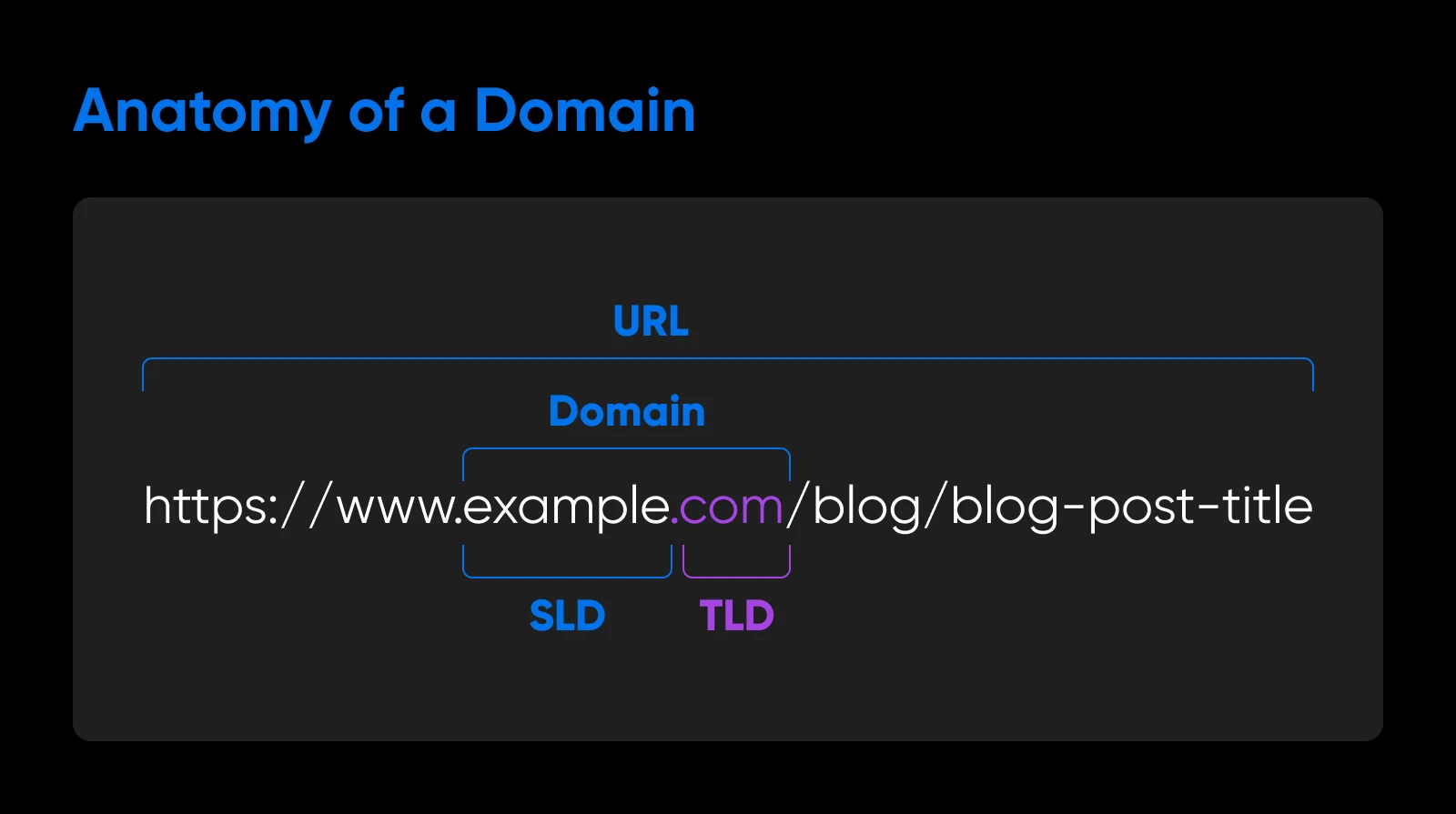
But how do you know that? Who decides which TLDs are best for SEO, and which ones make your brand look trustworthy?
Spoiler: This doesn’t come from divine wisdom handed down by internet gods—it’s just marketing.
Who’s Pushing These Myths, Anyway?
The domain industry is made up of a few key players, each with their own motivations.
- Registries: These are the folks who operate each domain extension (.com, .org, .pizza — yes, that’s real). They set wholesale pricing and decide how their TLD is marketed, though not always freely: Verisign’s .com wholesale price is capped by its registry agreement with ICANN. Many newer extensions also hold back premium inventory — one-word and short names — and set their own sale and renewal prices for it. That is not how .com and .org work: their most desirable names were registered long ago and now change hands on the aftermarket.
- Registrars: These are the companies that sell domains directly to you. Registrars sometimes run promos that can make one TLD seem like the “hot” choice, but it’s usually just market dynamics at work, not necessarily a signal of long-term superiority.
- Affiliates and marketers: Many of the blogs and videos insisting “.org is better for nonprofits” or “.com boosts SEO” earn commission when you buy a domain through their referral links. Their advice often sounds authoritative, but it’s not always unbiased.
- Domain investors: These are the domain flippers who buy up “prime” .com names and resell them for thousands. They have every incentive to convince you that .com is the one true domain extension, because that keeps their inventory valuable.
Why should you care about who’s talking? Because when you strip away the sales pitch, you realize most of the “rules” about domain extensions are less like hard science and more like urban legends. That doesn’t mean extensions don’t matter, but it does mean you need to weigh them against your actual goals instead of chasing what the loudest voice in the room is pushing.
Which Do People Trust More, .com or .org?
.com, though the margin is thinner than the marketing suggests. In GrowthBadger’s study of 1,500 people, published in 2019 and last updated in 2022, .com rated the most trusted extension at 3.5 out of 5, with .co close behind at 3.4 and .org tied with .us at 3.3.
The same study scored memorability separately, and .com won that test too: people correctly remembered the .com URL 44% of the time, compared with 33% for .co and 32% for .org.
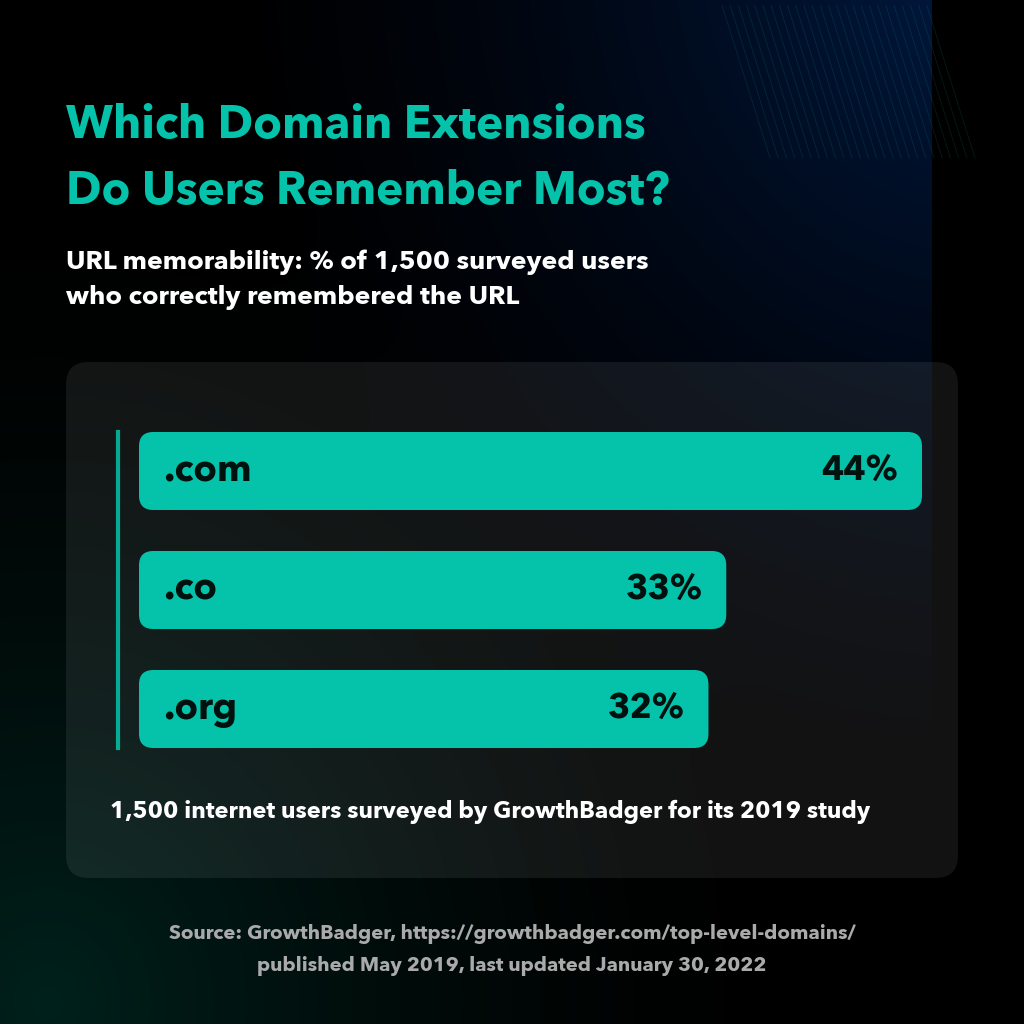
That gap matters, but it also shows .org keeps a strong reputation next to most alternatives. In the same study, .biz came in lowest on trust at 2.9, with .io not far above it.
The trust gap mainly comes down to cultural shorthand:
- .com has been the internet’s “main street” for decades. People default to it because it feels safe, familiar, and professional.
- .org is familiar and it carries an identity halo; people often associate it with nonprofits, education, or community causes. That can be a plus if you’re a charity or mission-driven group, but it may confuse customers if you run an e-commerce business.
What’s important to note, though, is that trust perception is a starting point, not the final word. If your brand delivers value, looks professional, and builds credibility over time, most users won’t care whether you’re a .com or a .org. That said, first impressions still matter, and your domain extension contributes to the snap judgments first-time visitors will make about your site.
So, should you pay attention to perception? Definitely. If you’re a business trying to signal professionalism and credibility to the broadest audience possible, .com is still the safe bet.
If you’re building a nonprofit, advocacy project, or open-source community, .org can certainly work for you. Jump to the nonprofit checklist for what to line up after the domain.
.com vs .org by the Numbers
Moving beyond people’s feelings, what do actual numbers say? Put it this way: if the internet had a popularity contest, .com would win by a landslide.
Across the entire internet, the scale is hard to picture: Verisign’s DNIB Quarterly Report, published July 23, 2026, counted 401.6 million domain name registrations across all top-level domains at the close of Q2 2026. .com is far and away the largest single slice of that total, and .org is nowhere near it on volume.
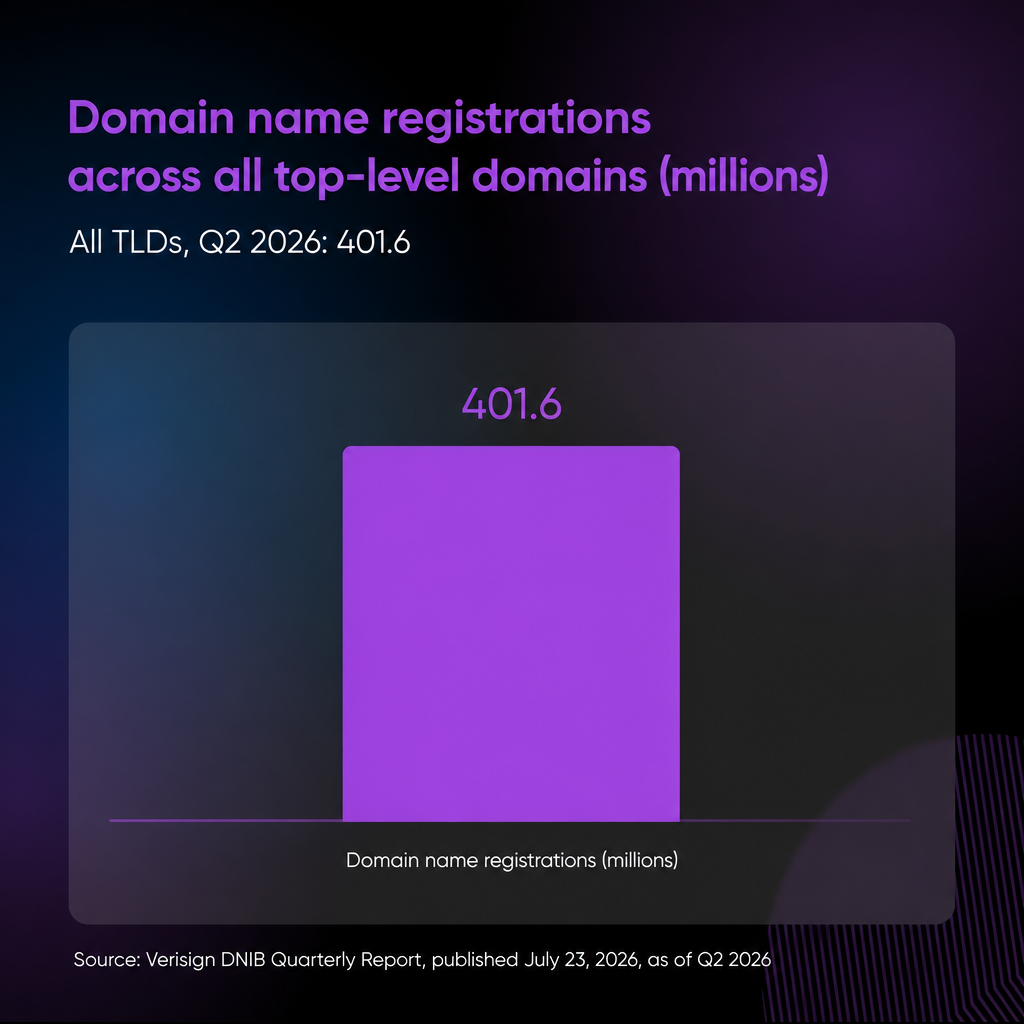
So yes, .com dominates in sheer volume. Popularity often creates its own momentum. People are used to typing “.com” by default, and businesses prefer it because it feels familiar. But is either domain extension inherently more powerful for your SEO or success? That’s still hotly debated across the internet.
If you’ve read this far and you’re thinking, “OK, but just tell me which one to pick so I can get back to running my business,” this cheat sheet is for you.
Here’s a quick framework:
That’s it. If you want a fast rule of thumb, follow those four points and you’ll make a solid choice.
But if you have more time and want to think strategically (especially if your brand might evolve in the future), keep reading.
In the next section, we’ll walk through a deeper framework that helps you evaluate more complex TLD decisions with confidence.
💡 Pro tip: Before you fall in love with a name, run a quick check using DreamHost’s domain search tool. You’ll see instantly if your .com or .org is available — and what backup options exist. Brainstorming candidates with an AI chatbot or a registrar name generator is fine, but they cheerfully suggest names that are already registered, so run every favorite through a real availability check.
Deeper Decision Framework for Strategic Domains
If you want to choose a domain extension that supports your brand long-term, here’s the deeper version of the .com-or-.org call, plus what to do when both are taken. (For a full tour of every other extension, see our guide to choosing domain extensions.)
1. Start With Audience Expectations and Align With Your Brand Story
Your domain extension can reinforce your brand identity. If your extension matches what you do, it can reinforce your messaging. But don’t use a trendy TLD just to look cool — your brand should lead, not the other way around.
- .com: Still the default. If you’re building a business or brand aimed at the general public, .com feels familiar and professional.
- .org: Best for nonprofits, advocacy groups, and communities. People often assume .org = mission-driven.
- .net: Once a solid alternative, but it’s lost ground. It can work if your brand name is taken on .com and .org, but know that some people may confuse it with .com.
- .shop or .store: A great fit for e-commerce sites. These instantly signal that you’re selling something online, which can help conversions.
- .ai: Popular with tech startups and companies working in artificial intelligence (AI). It’s buzzy now, but think about longevity. Will it still feel fresh in five years?
- .io: Widely adopted by startups, especially in software. It feels innovative but isn’t always understood outside tech circles.
- .xyz: A favorite among Web3 projects and creative brands that want to look unconventional.
Ask yourself what your visitors will expect to type if they’re trying to find you from memory. Keep in mind Google Search Central’s position, published July 21, 2015: “Overall, our systems treat new gTLDs like other gTLDs (like .com and .org). Keywords in a TLD do not give any advantage or disadvantage in search.” That means .com doesn’t have a secret SEO advantage over .ai or .shop.
Don’t choose your domain extension because you think it’s an SEO hack. Choose it because it makes sense for your business and target audience.
2. Think About Long-Term Scalability
Some TLDs are fun for a side project but may not age well if you expand. For example:
- A boutique online shop might launch on .shop, but if they later expand into events or education, a .com may scale better.
- A tech company might embrace .ai now, but what if they branch into unrelated services?
Consider whether your TLD will still make sense if your business pivots or grows. If you’re unsure, default to a mainstream option like .com or .org.
Like we said before, it’s also a good idea to grab multiple domains if they’re available and affordable. This prevents copycats from confusing your audience. Think of domain protection as digital insurance — you might never use the extras, but owning them keeps your brand safe.
The final part of scalability is choosing your domain carefully so you don’t need to change it later. Switching domains isn’t impossible, but it’s a hassle you probably don’t want, for multiple reasons.
- SEO impact: Yes, you can set up redirects and eventually transfer most of your search rankings to a new domain, but it takes time, and you’ll almost always see a temporary dip in traffic.
- Branding: Your old domain will still be floating around on business cards, social media posts, and even word-of-mouth. Training people to use your new domain takes effort — and sometimes, you’ll lose them in the shuffle.
- Cost: Beyond the registration price, you also have to factor in redesigning marketing collateral, updating email addresses, and reprinting physical assets.
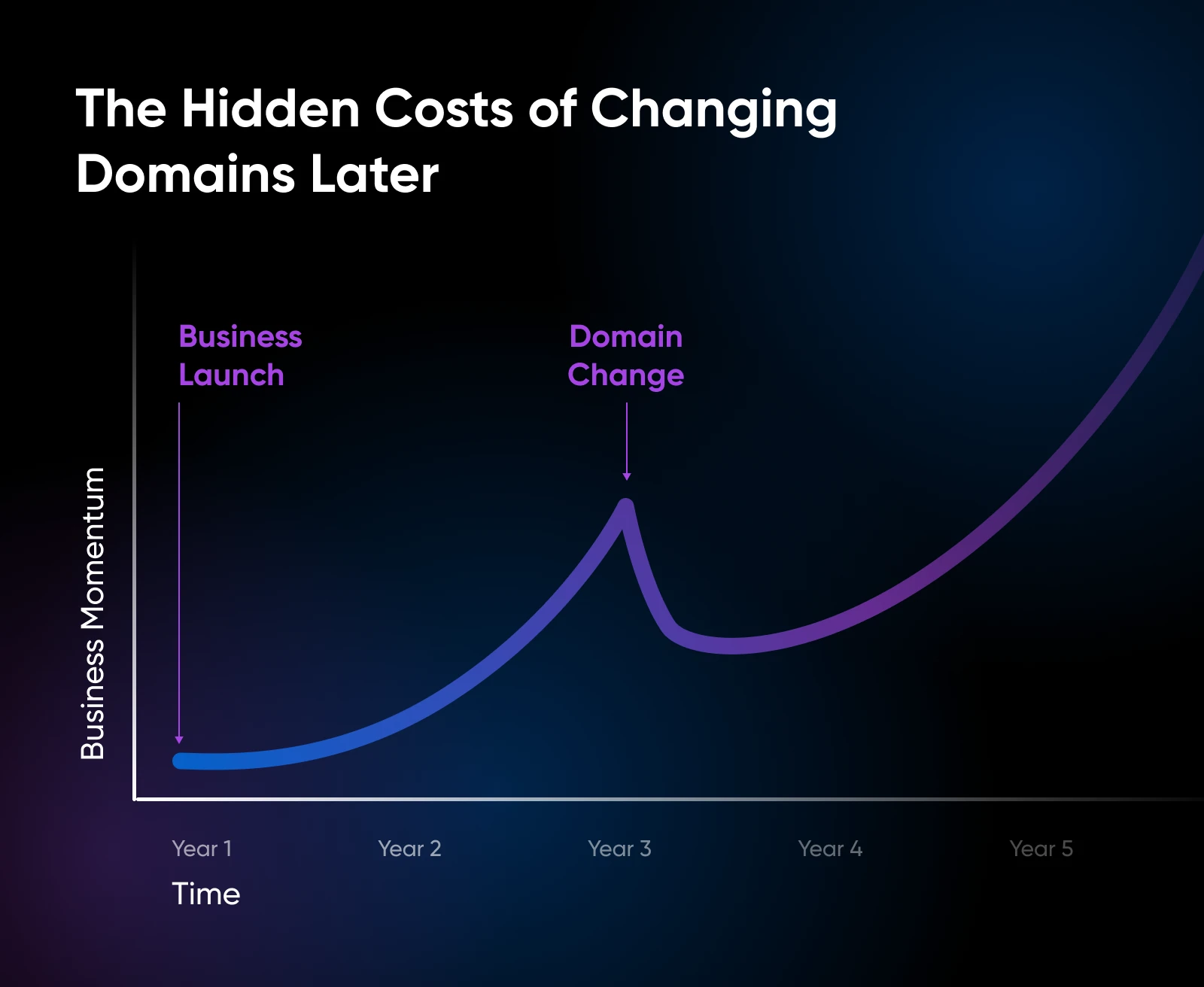
Does that mean you’re doomed if you pick the “wrong” domain now? Not at all. Many successful businesses have rebranded and survived just fine. But if you can make a thoughtful decision now, you can save yourself some “why didn’t I just buy the .com?” headaches down the line.
3. When .com Isn’t Available (or Costs Too Much)
What if you’ve brainstormed the perfect name, you’re ready to register it…and the .com is already taken? Or worse — it’s “available” through a broker for thousands of dollars you can’t afford?
Don’t panic. This happens all the time, and it doesn’t mean your business is doomed. Here are your options:
- Try the .org, if it fits: If you’re a nonprofit, school, or advocacy group, .org is a natural alternative. Even for some small businesses, .org can work if it aligns with your mission-driven identity.
- Look at modern alternatives: Extensions like .net, .io, .ai, or .xyz can work if they feel natural for your audience. Just be careful because not every trendy TLD will age well.
- Adjust your domain name: Adding a small tweak, like “get,” “shop,” or “co” before your brand name, can open up a .com without hurting memorability. For example, “evergreenplants.com” might be taken, but “shopevergreen.com” could be wide open.
- Buy the premium .com (but weigh the ROI): Sometimes, investing in the exact .com you want makes sense. But unless you’ve got a venture-backed startup budget (or you’re able to secure a payment plan or lease-to-own deal on the perfect domain), think hard before dropping thousands of dollars. Ask yourself: Will owning this exact .com pay off in customer trust, traffic, or branding down the road?
- And if you go with the pricey .com: Be sure to use a reputable broker who can ensure a clean transfer of ownership. Many services claim to handle this, but sometimes take the money without delivering the domain name.
If You’re a Nonprofit: .org and What Comes Next
You don’t need 501(c)(3) paperwork to register a .org. Public Interest Registry, the registry that runs the extension, is blunt about it: “Yes, .ORG is an open and unrestricted domain. Anyone is allowed to register and use .ORG domain names.” No approval, no proof of charitable status, no waiting period. It’s the same first-come, first-served process as a .com. (Contrast that with .gov, where get.gov verifies every requester and only U.S. government organizations qualify.)
So the domain is the easy part. Here’s the rest of the list for a nonprofit getting online:
What does .org stand for?
Organization. Public Interest Registry, the registry that operates .org, describes it as the home of millions of nonprofit, charitable, educational, cultural, and religious sites. That association is convention, not a rule: individuals and companies run .org sites for their community and volunteer work too.
Can anyone register a .org domain?
Yes. Public Interest Registry calls .org “an open and unrestricted domain,” with no 501(c)(3) requirement, no approval step, and no waiting period. It is the same first-come, first-served process as registering a .com.
Does .com rank better than .org in Google?
No. Google Search Central’s guidance, published July 21, 2015, says “our systems treat new gTLDs like other gTLDs (like .com and .org)” and that “Keywords in a TLD do not give any advantage or disadvantage in search.” Content, links, and experience decide rankings.
Should I buy both the .com and the .org?
If both are available and cheap, yes. Register both and redirect one to the other. It covers visitors who guess wrong and keeps a copycat off your name. If the budget is tight, buy the one your audience will actually type.
What should I use if both .com and .org are taken?
Adjust the name before you chase an exotic extension: shopevergreen.com beats a TLD nobody can spell. If that fails, .co, .net, .io, .ai, and .shop all work when they fit your audience. Check the renewal price, not just the first-year promo.
Choose the Domain That Works for You
So, should you get a .com or a .org? The short answer: it depends on your goals.
The most important takeaway? Your domain extension isn’t a magic bullet for SEO or success. What matters is how well it matches your audience’s expectations, your brand story, and your long-term goals. When you align those pieces, you’ll build trust and recognition no matter what comes after the dot.
At DreamHost, we’ve been helping people choose and register domains for decades…long enough to see every trend, myth, and fad in the book. We know what really matters when you’re laying the foundation of your online presence, and we’re here to make sure you start strong.
Ready to claim your domain and make it official? Head over to DreamHost Domains to search, register, and protect your perfect name today. Your brand’s next chapter starts with the right domain — let’s lock it in.

Domains
Your Great Idea Starts with a Domain Name
A custom domain gives your site a professional look, strengthens your brand, and helps visitors find you on the web.
See More
Did you enjoy this article?

